EPOXH, 17 May 2026 — By Olga Nassis
What do Pope Francis, Francesca Albanese, the students blocking a weapons train in Pisa, feminist political culture, and the housing rights movement have in common?
At first glance, they might seem like distant worlds, fragments of a resistance struggling to communicate. Yet today they are bound by a resilient common thread: a visceral rejection of war and a global economy that is militarising every aspect of our existence. They show us that salvation will not fall from above, from the corridors of power where arms deals are struck, but will rise from a radical, grassroots human mobilisation.
What is ‘Antipolemos’? It is not just another political party, nor a hierarchical structure seeking ‘great leaders’. It is a genuinely open infrastructure, a coordination platform accessible to all. Born in Greece but with a European and internationalist outlook, it is a space designed for collectives, activists, and ordinary people who, in the isolation of their daily lives, feel powerless in the face of the sheer scale of the tragedy of war.
History teaches us that vertical structures are easily ‘decapitated’. In Antipolemos, power and knowledge do not sit at the top of a pyramid; they flow horizontally. It is a culture of collective care and listening that stands against authoritarianism. A network conceived in this way simply cannot be destroyed, because it lives wherever there is a node that gives it life.
The power of the white flag “He is stronger who thinks of the people, who has the courage of the white flag.” These words from Pope Francis shook global public opinion, overturning decades of nationalist rhetoric. It is not an invitation to surrender, but a recognition of the ultimate courage needed to halt the massacre before the point of no return.
Francesca Albanese, the UN Special Rapporteur, shares this sentiment: “Alone we are as fragile as butterfly wings, but united we can create a storm.” Albanese has been targeted of unprecedented sanctions and pressure simply for rigorously documenting the genocide of the Palestinian people. When a human rights defender is even prevented from opening a bank account, we understand that violence has already encroached upon the territory of civil liberties.
This lesson has been deeply understood by the students of the No Base movement. In Pisa, they proved that the war machine can physically be jammed. At first, there were only fifteen of them on the tracks in front of a train loaded with weapons. They did not yield until hundreds of fellow citizens arrived to back them up, forcing the convoy to turn around. War is not only decided in diplomatic chancelleries; it is stopped in our streets, in our ports, and in our workplaces.
The intersection of struggles On 6 May, during the first Antipolemos assembly, various initiatives sat at the same virtual table to demonstrate that our concerns share a common root and are interconnected: every euro spent on a missile is a euro stolen from social housing, as highlighted by the International Alliance of Inhabitants and the historic Prosfygika Community of Leoforou Alexandras.
Armies are the planet’s primary polluters: war is ecocide, a concept reiterated by environmental movements such as Anemos Ananeosis and Stop Rearm Europe. While war-driven inflation devours wages, the arms industry posts record profits. And as ecofeminist networks point out, war is the apotheosis of patriarchal violence, a system of domination based on oppression.
Alongside historic initiatives such as the movement to “Close the Souda Base”, “ΚόσμοςΧωρίςΠόλεμο&Βία” (A World Without War & Violence), the REDH international network, Cuban solidarity delegations, the Think Act Left collective, and the Left Dialogue Space, individual citizens and students joined the call. Defending the climate, housing, or human rights today means, in practical terms, taking a radical stance against war and imperialism.
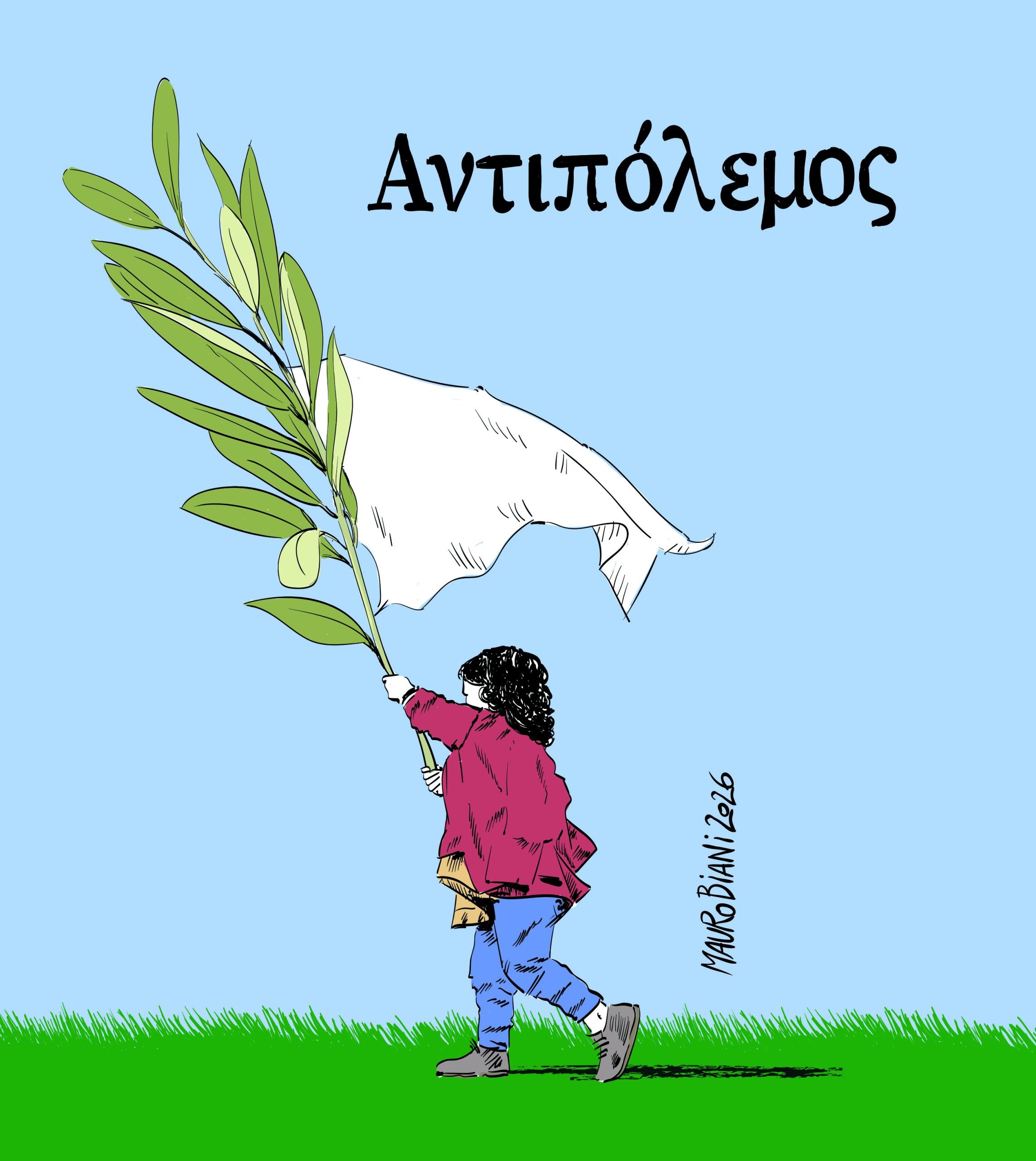
The symbol and the toolkit for action ‘in unison’ To unite these diverse voices required a symbol that speaks to the heart. It was designed by Mauro Biani, a master of non-violent satire. Biani stripped the white flag of its stigma of cowardice, placing it alongside an olive branch—the symbol of universal peace with its rootsin Athens—and combining two Greek words, as ancient as they are alive: Anti-polemos [Anti-war]
Yet indignation, without practical tools, risks evaporating. That is why Antipolemos has created a shared digital Toolkit. It is not a static manifesto, but an open ‘toolbox’. Anyone can access it to download graphics, propose slogans, or register their action on an interactive map. The goal is simultaneous, widespread action: when dozens of small dots light up at the same time on the map of Europe, isolation is broken and the message becomes unstoppable. It is the ‘butterfly effect’ applied to social resistance.
The milestones of Antipolemos
15-16 May, Athens: We are participating in the Festival of the Commons, because peace is our most precious common good.
17 May, Crete: We will stand before the Souda base to demand its closure: no more outposts of death in the heart of the Mediterranean.
30 May: The launch Memory is not a dusty archive, but an active reflex to be translated into present action. On 30 May 1941, two students, Manolis Glezos and Apostolos Santas, scaled the Parthenon to tear down the humiliating Nazi flag. It was an act of incredible audacity that gave hope to the whole of occupied Europe.
Drawing on this inspiration, on 30 May we will perform our own “act of ascent”. Antipolemos asks you to find your own Acropolis—whether it is a square, a school, a factory, or your own balcony—and raise a symbol of peace, lighting up a point on our peace map. It is not a finish line, but the beginning of an enduring solidarity. We are as fragile as butterflies, it is true. But united, we are ready to unleash the storm that will stop the war.
An invitation to participation and common action. You will find the toolkit, Biani’s graphics, and the map to register your action at: https://antipolemos.org/